Thank you!
We need to fund this campaign ASAP! Get your friends involved
Share this fundraiser on Instagram
Together, we can achieve great things!
In modern warfare, the statistics are relentless:
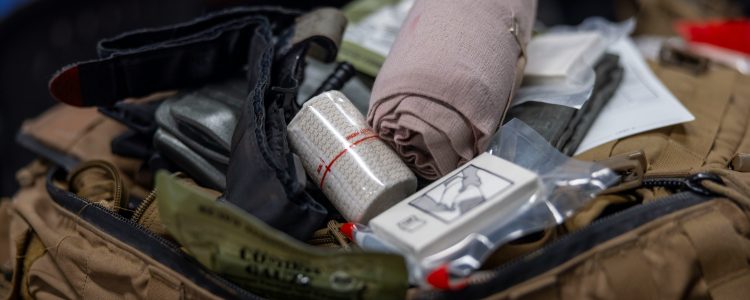
In modern warfare, the statistics are relentless: most preventable deaths occur due to massive bleeding in the first minutes after injury. That is why a military first aid kit is not a formal piece of equipment, but a personal life-saving tool that a soldier must know how to use independently or to provide assistance to a fellow soldier.
In the armies of NATO countries, such a kit is called an IFAK (Individual First Aid Kit), and in the Armed Forces of Ukraine — AMZI (individual general military medical first aid kit). Its contents are strictly regulated and built around a clear sequence of actions verified by combat experience.
In this material, we will examine what exactly should be included in a military first aid kit under official standards, why each item is needed, and why it is fundamentally different from an ordinary home first aid kit. All information is based on data from the Ministry of Defence of Ukraine and international tactical medicine protocols.
An individual service member’s first aid kit is a mandatory piece of equipment issued by the state to every defender. According to the Ministry of Defence, its contents are regulated by Ministry of Defence Order No. 506 of July 24, 2024, which established the transition of the Armed Forces of Ukraine to tactical medicine standards based on the best practices of foreign partners and Ukraine’s own wartime experience.
The key difference between a military and a household first aid kit lies in its purpose. A home or vehicle first aid kit (for example, one based on Red Cross recommendations) is intended for everyday injuries: scratches, burns, headaches. A military first aid kit is designed for one main task — to save a life in the event of a combat injury, primarily by stopping critical bleeding before a medic arrives or evacuation takes place.
The AMZI contents are as close as possible to the international IFAK standard used by the armies of NATO member countries and fully cover the stages of care under the TCCC (Tactical Combat Casualty Care) protocol.
To understand the contents of a military first aid kit, it is first necessary to understand the MARCH algorithm — the sequence of actions when providing assistance to a wounded person in extreme conditions. Each letter represents a life-threatening condition in order of danger: what kills the fastest is addressed first.
| Letter | Meaning | Care priority |
| M | Massive hemorrhage — massive bleeding | Immediately stop critical bleeding (tourniquet, hemostatic agent, pressure dressing) |
| A | Airway — airway | Ensure airway patency |
| R | Respiration — breathing | Care for chest injuries (chest seals) |
| C | Circulation — circulation | Condition monitoring, anti-shock measures, access |
| H | Head/Hypothermia — head/hypothermia | Protection from hypothermia, monitoring for traumatic brain injury |
Table 1. The MARCH algorithm — the basis of the TCCC protocol according to which the first aid kit contents are assembled.
That is why the contents of the first aid kit are not random: each item corresponds to a specific step of this algorithm. The greatest attention is given to the letter “M” — massive bleeding, since it is the leading cause of preventable deaths on the battlefield.
Below is the functional composition of the first aid kit according to the regulations of the Ministry of Defence of Ukraine, grouped by purpose.
This is the heart of the first aid kit and its most important part.
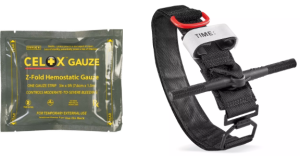
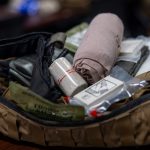
A tourniquet and hemostatic bandage — means for stopping massive bleeding, step “M” of the MARCH protocol.
A pharmacological kit, or “pill-pack,” is the global standard of battlefield care when a qualified medic is not nearby. According to the Ministry of Defence of Ukraine, it contains:
Important: the list and dosage of medications are established by regulations, and they should be used only in accordance with the protocol and existing contraindications.
An often underestimated but critically important item. It is a specialized medical form made of moisture-resistant synthetic material that is resistant to damage and liquids. According to the Ministry of Defence, it performs three functions:
This is a direct implementation of the NATO Triage Tag principle — mandatory casualty labeling and documentation of care to ensure continuity of medical treatment.
The Ukrainian AMZI first aid kit is not merely a set of supplies, but a systematic tool that meets the requirements of the Committee on Tactical Combat Casualty Care (CoTCCC). The requirements for dimensions and characteristics — bandage length, the presence of a valve on the occlusive dressing, and the tourniquet type — are effectively identical to NATO requirements.
According to international recommendations, a minimum CoTCCC-compatible IFAK contains: a tourniquet, hemostatic bandage, pressure dressing, a pair of vented chest seals, a nasopharyngeal airway, compressed gauze, nitrile gloves, trauma shears, a marker, and an emergency blanket. The Ukrainian kit not only corresponds to this list but also reinforces it with two tourniquets and two hemostatic agents instead of one.
To clearly demonstrate the difference in approaches, let us compare the two kit assembly principles.
The main conclusion: a household first aid kit does not replace a military one. Having a factory-made, certified tourniquet and knowing how to use it saves lives where an ordinary bandage is powerless.
A modern military first aid kit is a high-tech, standardized tool, each item of which has a clearly defined purpose in the MARCH life-saving algorithm. From two tourniquets and hemostatic agents to chest seals and a casualty card — everything serves one purpose: to give a soldier a chance to survive until qualified assistance is available.
But even the best standard works only when every defender physically has a first aid kit and it is equipped with high-quality supplies. This is where support from the rear is critically important.
Join the “Medicines for the Military 2.0” fundraiser
Every fully equipped first aid kit and every tourniquet is a real chance of survival for our defender. The People’s Project foundation purchases tactical medical supplies, tourniquets, hemostatic bandages, and medicines and delivers them to the front. You can support the fundraiser via the link: